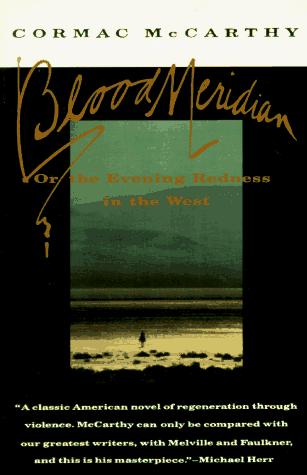
I generally think of myself as fairly desensitized to violence on the page, and this book still managed to surprise me. It isn’t the violence itself that gets you, it’s how McCarthy renders it, sparse, almost biblical in cadence, never gratuitous or lingering for effect, which somehow makes it land harder than a book that tried to shock you on purpose. The prose does the actual work here, that dense, King James-adjacent sentence structure that most writers can’t touch without sounding like they’re doing an impression, and McCarthy just writes like that’s the only register he owns.
Structurally this is closer to a string of horrors than a plot, the kid and the Glanton gang moving from atrocity to atrocity across a desert that doesn’t care whether they live, and I understand why some readers bounce off that, there isn’t a conventional arc pulling you forward the way genre fiction trains you to expect one. What kept me reading was the Judge, one of the strangest and most purely unsettling characters I’ve encountered on the page, an enormous, hairless, articulate presence who shows up to philosophize about war being the truest form of divination right before or right after something horrific happens. He never gets explained. He doesn’t need to be.
Full of sound and fury signifying nothing, is one way to read it, and there’s a version of this book where that reading holds. I don’t buy it fully. There’s something almost meditative under the brutality, a stark, evocative quality to the landscape writing that keeps pulling you back even when the content is genuinely hard to sit with. Not a book I’d hand to someone looking for comfort. For anyone who wants to see how far American prose can be pushed toward something like scripture, this is the one.