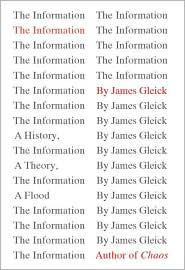
Nothing in here is really new information, so to speak, if you’ve read around this subject before, but Gleick’s actual skill is pulling a genuinely huge subject into something that holds together instead of scattering into a dozen disconnected essays. He starts with African talking drums, of all things, an entire information technology built on tonal language that European travelers completely misread as primitive noise because they didn’t understand what it was actually encoding, and from there he walks the line all the way through cuneiform, the dictionary, the telegraph, and into Shannon’s information theory without ever losing the connective tissue between them.
The Shannon material is where the book earns its keep for me. I liked the emphasis on how much of modern life runs on a guy most people have never heard of, the idea that information can be measured, quantified, separated from meaning entirely, and once you can measure it you can compress it, transmit it, corrupt it and detect the corruption. Gleick doesn’t dumb this down, he’s not afraid to actually walk through the equations and the historical arguments around entropy, which I respect even in the stretches where I had to reread a paragraph twice.
Where it loses some readers, myself included in patches, is the sheer density of the back half, once the book gets into quantum information and genetics as information systems, it can feel like it’s chasing every possible tangent instead of landing the plane. I didn’t mind the sprawl as much as some, an ambitious book about the nature of information itself probably has to sprawl a little to make its case. Still glad I stuck it out to the end instead of bowing out at the halfway point, which I’ll admit I was tempted to do around the two hundred page mark.